Showing posts with label vintage. Show all posts

Thursday, December 9, 2021

What a find!


I came across this excellent website, the Wellcome Collection. It is a free museum and library in London which creates “opportunities for people to think deeply about the connections between science, medicine, life and art.” Among other fascinating content, I found some beautiful — and free! — public domain images in their digitized collections. Below are some examples.


The anatomy of a horse by Andrew Snape, 1687

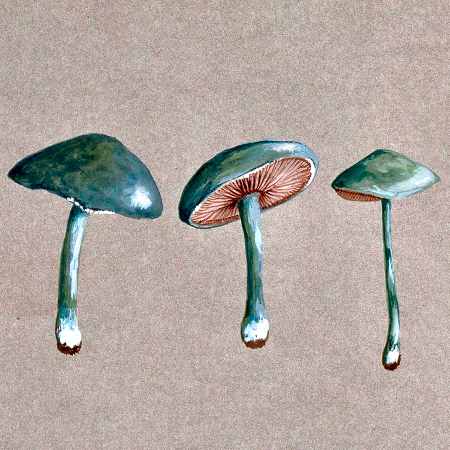
Fruiting fungus (Stropharia aeruginosa), 1883
Fruiting fungus (Stropharia aeruginosa)
watercolour, 1883 — modified t.g.

Florence Nightingale by W. Wellstood, 1856
Florence Nightingale
line engraving by W. Wellstood, 1856,
after J. B. Wandesforde — cropped t.g.

mixed media art, 1800s
A rose with lettering. Coloured cut
paper work with letterpress, 1800s.

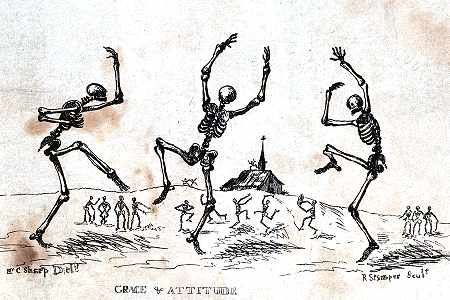
Skeletons dancing. Etching by R. Stamper, 1700s
Skeletons dancing. Etching by R. Stamper
after C. Sharp, 1700s — modified t.g.

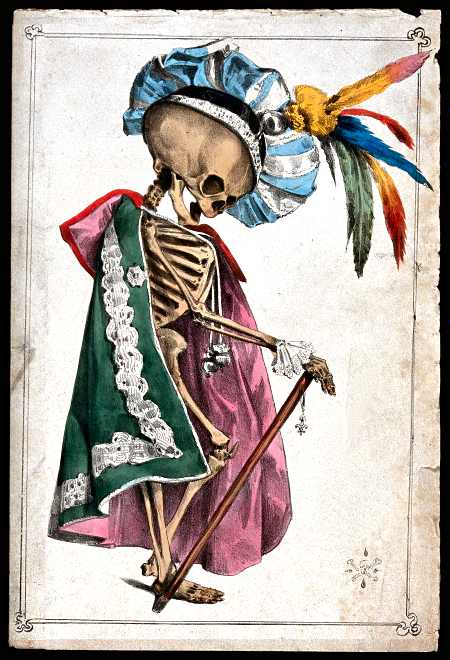
A skeleton in fine attire, 1800s
A skeleton in fine attire.
Lithograph, 1800s — modified t.g.

L’art de connaître les hommes par la physionomie by M. Moreau, 1800s
L’art de connaître les hommes par la physionomie.
M. Moreau, 1806–1809

pink roses
A rose (Rosa species): flowering stem and
cut flower. Watercolour — modified t.g.

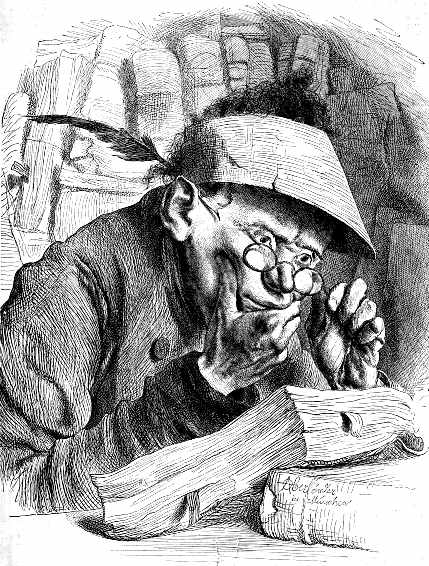
A young man with spectacles, wood engraving
A young man sits reading ledgers at his desk
wearing spectacles and an eyeshade. Wood engraving
after A. Oberländer — modified t.g.


Thursday, June 25, 2015

And be a friend to man...


The House by the Side of the Road

      “He was a friend to man,
      and lived in a house by the
      side of the road.”
      —Homer


There are hermit souls that live withdrawn
    In the peace of their self-content;
There are souls, like stars, that dwell apart,
    In a fellowless firmament;
There are pioneer souls that blaze their paths
    Where highways never ran;—
But let me live by the side of the road
    And be a friend to man.

Let me live in a house by the side of the road,
    Where the race of men go by—
The men who are good and the men who are bad,
    As good and as bad as I.
I would not sit in the scorner's seat,
    Or hurl the cynic's ban;—
Let me live in a house by the side of the road
    And be a friend to man.

I see from my house by the side of the road,
    By the side of the highway of life,
The men who press with the ardor of hope,
    The men who are faint with the strife.
But I turn not away from their smiles nor their tears—
    Both parts of an infinite plan;—
Let me live in my house by the side of the road
    And be a friend to man.

I know there are brook-gladdened meadows ahead
    And mountains of wearisome height;
That the road passes on through the long afternoon
    And stretches away to the night.
But still I rejoice when the travellers rejoice,
    And weep with the strangers that moan,
Nor live in my house by the side of the road
    Like a man who dwells alone.

Let me live in my house by the side of the road
    Where the race of men go by—
They are good, they are bad, they are weak, they are strong,
    Wise, foolish—so am I.
Then why should I sit in the scorner's seat
    Or hurl the cynic's ban?—
Let me live in my house by the side of the road
    And be a friend to man.

—Sam Walter Foss (1858–1911)

“The House by the Side of the Road” was published in The Independent, 1897, and in Foss’ own book, Dreams in Homespun. According to The Alumnæ News of The Normal College, New York, the sentiments of this poem were inspired by the Roadside Settlement in Des Moines, Iowa. And the wording was inspired by Homer, as seen in the epigraph to this beautiful poem. I’m not the best of Greek scholars, but I think the excerpt would be:
          “Axylus: in Arisba fair he dwelt
          With riches blest, near to the public way
          His dwelling: thus a general friend to man
          He lov’d them all, and all their wants reliev’d...”

And as if Foss’ poetry wasn’t enough to give me joy, get this — he was also a librarian. Swoon!

Sam Walter Foss (1858–1911)


Image source: “A Poet of the Common Life: Editorial Sketch of Sam Walter Foss,” in The Coming Age, October 1899

Sunday, September 14, 2014

As is the generation of leaves


Apparently quotation collecting is genetic. Ten years ago, which was 18 years after I had already become obsessed with quotes, I learned that my great-grandmother Amy kept a notebook of inspirational quotations. She was born in 1896 and died before I was born. My grandma found the book and that is how it came to me. Based on the dates of the first items, it appears to be about a hundred years old. The first item that is dated is from 1919, and the last entry with a date is from 1969. Click photos to enlarge.

my great-grandmother's commonplace book

my great-grandmother's commonplace book

my great-grandmother's commonplace book

“As is the generation of leaves, so is that of humanity.
The wind scatters the leaves on the ground, but the live timber
Burgeons with leaves again in the season of spring returning.
So one generation of men will grow while another dies.”
—Homer


Tuesday, April 22, 2014

Sunday, June 24, 2012

Quotations about quotations


Recently I've been reading some fascinating books on the history and genre of quotations, most notably Quotology by Willis Goth Regier. I've also spent hundreds of hours improving the accuracy and depth of my “Quotations about Quotations” page on The Quote Garden by tracing down original works for verification and culling a couple of hundred new items not posted on any other website, both from the long-lost treasures on Google Books and from my own collection of dusty books. I am quite certain that I’ve accumulated over the past 26 years what is the world's largest collection of quotes about quotes. If not, it is certainly the most accessible large collection.

I found it exciting to learn that people have been taking delight in quotations — and struggling with misquotation — for centuries. Quotation anthologies have been around for ages, but according to Willis Goth Regier, “The watershed for compendia was in the mid‑1850s.” Imagine how much more abundant the watershed — or how much earlier — had the internet been around back in the day!

While researching the origin and context of the quotations, I would frequently get sidetracked reading antique gems of books and authors, stumbling upon some of the most amazing writing that is still sparkling and relevant up to this very day. I'd like to share one of my finds with you all. I was trying to locate the origin of this quote:

          “Shake was a dramatist of note;
          He lived by writing things to quote...”

Thanks to Google Books, I was able to determine the author as V. Hugo Dusenbury. The full poem was posted in the January 28th 1880 edition of Puck, and it is so good I resurrect it here 132 years later for your reading pleasure — click the image to view full-size. The entire Puck periodical, in fact, was brimming with cleverness and I spent quite a happy time perusing it.

Puck, 1880, digitized by Google Books

If you’d like to browse my new and improved page of quotations about quotations, you can find it here: www.quotegarden.com/quotations.html. My most heartfelt gratitude goes out to all the ancient and modern persons who have pointed the way and left behind clues for where to focus my searches over the years which have led me to all these glorious “choice flowers, culled from the gardens of Poesy” (H.G. Adams).

Update, November 2012:  Thanks to Garson O’Toole, The Quote Investigator, I’ve learned that V. Hugo Dusenbury was a pseudonym of Henry Cuyler Bunner, the editor of Puck.